

Why Water Always Wins (Unless You Give It Somewhere Else to Go)
One of the biggest misconceptions homeowners have about drainage is that the goal is to stop water.
It isn't.
Water is incredibly predictable. Every drop of rain that lands on your property is trying to do one thing—it wants to travel downhill.
You can't stop gravity.
You can't waterproof your entire backyard.
You certainly can't expect retaining walls to permanently hold back thousands of litres of water every time it rains.
Good drainage isn't about fighting water.
It's about giving water an easier path than your house.
That was exactly the challenge at this Avalon Beach property.
When One Small Lawn Becomes a River
From the surface, the problem looked fairly simple.
A narrow strip of lawn between two retaining walls became saturated after heavy rain. Water pooled, the ground remained soft for days afterwards, and every major storm seemed to create the same mess.
But what homeowners often don't realise is that the water they can see is usually only a fraction of what's actually happening.
Above ground, rainwater was rushing downhill from higher parts of the property.
Below ground, something else was happening entirely.
As rain soaked into the soil uphill, groundwater slowly began migrating beneath the surface towards the retaining walls.
By the time water appeared on the lawn, the soil underneath was already acting like a saturated sponge.
The property wasn't suffering from one drainage problem.
It had two completely different water systems arriving at exactly the same location.
Surface Water and Groundwater Behave Completely Differently
One of the biggest mistakes people make is assuming all water behaves the same.
Surface water is fast.
It flows over driveways, paths and lawns during heavy rainfall.
Groundwater is much slower.
It can spend days moving through the soil before eventually appearing hundreds of millimetres—or even metres—from where the rain originally fell.
That's why homeowners are often confused when they notice wet ground several days after the rain has stopped.
The storm has passed.
But underground, the water is still travelling.
Treating only the surface water would have left the hidden groundwater pressure untouched.
Treating only the groundwater would still leave heavy rainfall rushing down the slope.
Both problems needed solving.
Building a Drainage System That Thinks Like Water
Rather than installing one oversized drain and hoping for the best, our team designed a drainage system that intercepted water at every stage of its journey.
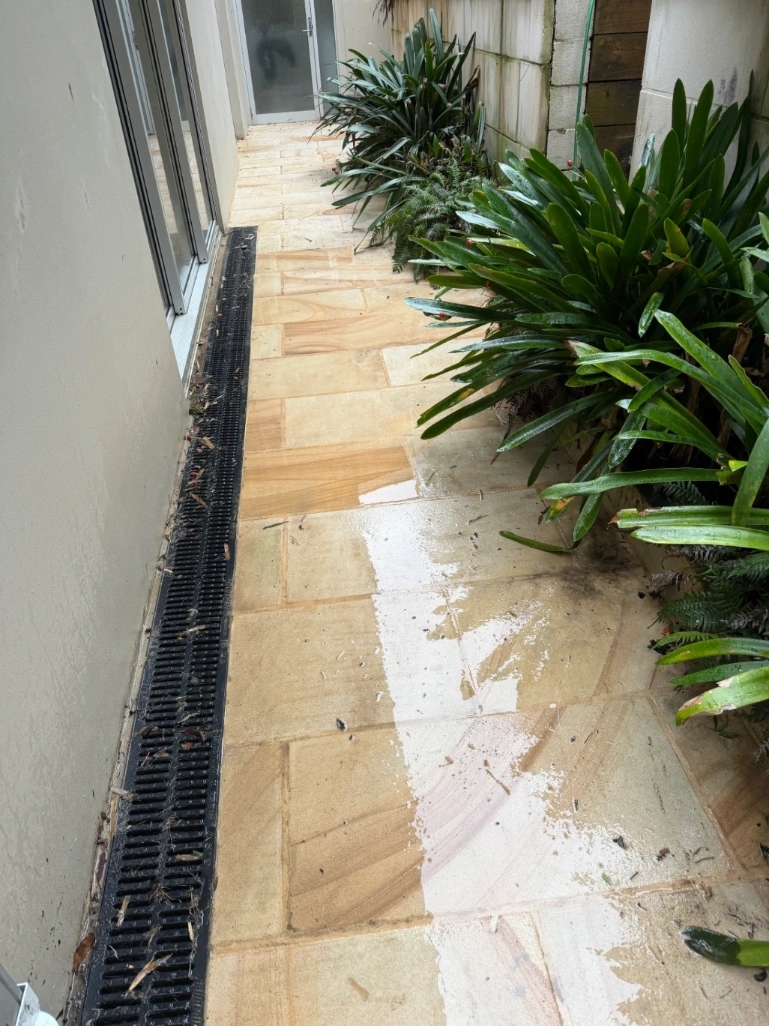
At the surface, a channel drain was positioned where runoff naturally concentrated at the base of the retaining wall.
Its job was simple.
Capture fast-moving stormwater before it could spread across the lawn.
Below the surface, an agricultural drain (AG drain) quietly performed a completely different task.
Instead of collecting visible water, it intercepted groundwater travelling invisibly through the surrounding soil.
These two systems then worked together.
Surface water entered immediately.
Groundwater filtered gradually through blue metal aggregate before entering the AG drain.
Both eventually discharged into a heavy-duty PVC collector line before flowing safely into the property's existing stormwater infrastructure.
Instead of allowing water to choose its own path, the drainage system chose one for it.
Planning for the Storm You Hope Never Comes
One of the most interesting parts of this project wasn't actually the main drainage system.
It was the backup.
The property already discharged into an existing drainage easement.
Normally, that works perfectly.
But drainage engineers also ask another question.
"What happens if that system becomes blocked during an extreme rainfall event?"
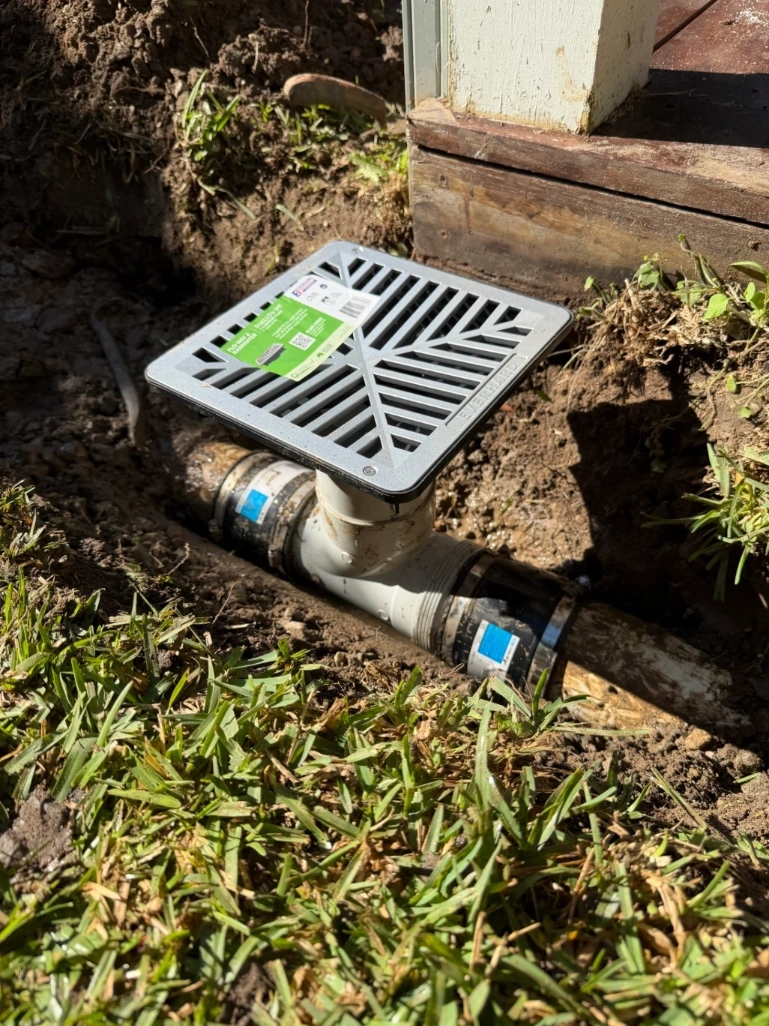
Rather than allowing pressure to build underground, our team installed a surface relief riser.
Think of it as a pressure relief valve for the drainage system.
If the downstream easement were ever to become overwhelmed or blocked, water now has a controlled location where it can safely escape instead of forcing its way backwards through underground pipework.
Most homeowners will hopefully never see it operate.
Which is exactly how good emergency design should work.
Drainage Isn't About Installing More Pipes
The best drainage projects rarely involve the most pipework.
They involve understanding how a particular property behaves.
Every block of land sheds water differently.
Every retaining wall changes groundwater movement.
Every slope creates new collection points.
The solution that works perfectly for one home may perform poorly just two streets away because the landscape behaves differently.
That's why drainage should never be treated as a commodity.
It should be designed specifically for the property sitting above it.
A Smarter Way to Manage Water
When the project was complete, the trenches were reinstated, the drainage system was tested and the site returned to its original appearance.
The visible difference was surprisingly small.
The real change happened underground.
Instead of allowing rainfall and groundwater to compete for the same space, the property now has a coordinated drainage network that manages both independently before safely bringing them back together.
Because in drainage, success isn't measured by the pipe you install.
It's measured by the water you never see again.
